
Ash content is one of the oldest and most dependable indicators of inorganic residue in a sample, and nearly every method that measures it relies on the same instrument: a muffle furnace that holds a precise, uniform temperature for hours without drifting. Whether you are testing coal, feed, flour, polymers, biomass pellets, or waste-derived fuel, the furnace you choose determines how repeatable and defensible your results will be. This guide explains what the ashing process actually demands from a furnace, which specifications separate a capable instrument from an average one, and how to match a model to your test standard and sample load.
Why Ashing Is a Furnace Test Before It Is a Chemistry Test
Ashing looks simple in principle: burn away all organic matter and weigh what remains. In practice, the reported ash percentage is a direct reflection of how the furnace behaves across the entire heating cycle, not just at the set point. Two laboratories using the same method and the same sample can report different ash values if their furnaces differ in ramp rate, chamber uniformity, or air exchange.
What Actually Happens Inside the Chamber
During ashing, the sample passes through three distinct stages. First, moisture and volatile matter evolve as the furnace ramps up. Second, the organic matrix oxidizes, which is where visible smoking and flame occur. Third, the inorganic residue reaches a constant weight during the soak period. Each stage places a different demand on the furnace, and a chamber that performs well at soak temperature can still fail during the volatile release stage if the ramp is too aggressive or the exhaust path is inadequate.
The Three Failure Modes That Ruin Ash Results
- Inconsistent chamber uniformity. If the corners of the chamber run cooler than the center, crucibles placed near the door will under-ash while those at the rear fully oxidize. The result is scatter between replicates that no amount of re-weighing can fix.
- Temperature overshoot during ramp. A controller that spikes above the target temperature can fuse the ash, trap carbon inside a glassy residue, and bias the final value low. Programmable ramp-and-soak control prevents this.
- Poor atmosphere exchange. Complete ashing is an oxidation reaction. If combustion products cannot escape and fresh air cannot enter, carbon remains locked in the residue and the ash content reads high.
Core Specifications to Compare Before You Buy
Once you know which standard governs your test, the specification sheet becomes much easier to read. The following parameters have the greatest influence on ash content accuracy.
- Maximum working temperature. Food, feed, and polymer methods typically ash at 550 °C to 600 °C, while coal, coke, and some mineral methods require 815 °C or higher. Buying a furnace rated well above your working temperature extends element life and shortens recovery time after the door opens.
- Chamber temperature uniformity. Look for a stated uniformity figure at soak, not just a control accuracy figure. Control accuracy describes the thermocouple reading; uniformity describes what your sample experiences.
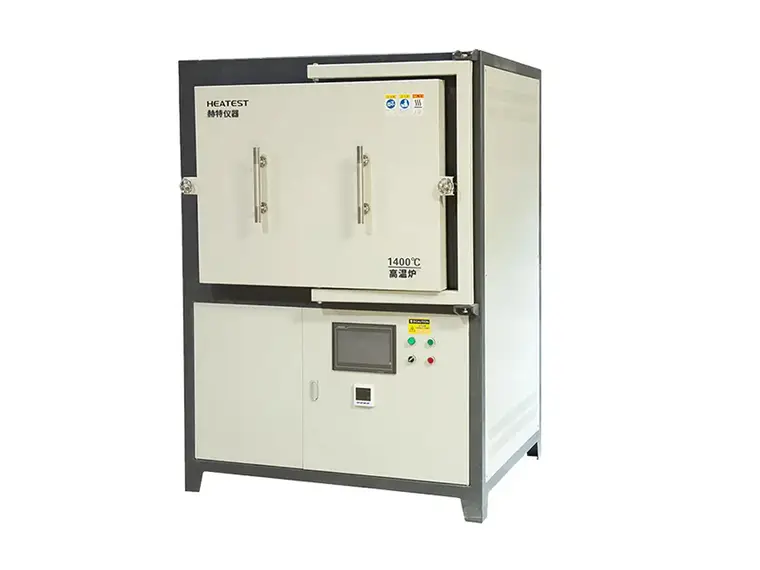
- Insulation type. Ceramic fiber insulation heats quickly and keeps the exterior cool, which shortens cycle time. Dense firebrick holds heat longer and recovers faster after sample loading. The right choice depends on how many batches you run per day.
- Heating elements. Resistance wire suits routine 1100 °C work. Silicon carbide and molybdenum disilicide elements are needed when the process demands sustained high temperature or fast recovery.
- Controller capability. Multi-step programmable profiles with adjustable ramp rates and dwell times are essential for ashing. Single set-point controllers force operators to watch the furnace manually.
- Exhaust and door design. A counterweighted door that opens flat simplifies crucible handling, and an adjustable exhaust port lets you control air exchange without losing heat.
- Safety systems. Over-temperature protection, door interlocks, and leakage-current protection are baseline expectations for unattended overnight ashing runs.
Types of Muffle Furnaces Used for Ashing: Advantages Compared
Several furnace configurations are marketed for ashing work, and each brings distinct advantages depending on sample type and throughput.
Box-Type Chamber Furnace with Ceramic Fiber Insulation
This is the workhorse configuration for ash content determination. Its advantages include:
- Fast heat-up and cool-down, so multiple batches can be completed in a single working day
- Large flat hearth that accepts dozens of crucibles or ash dishes at once
- Low exterior surface temperature, which improves operator safety in crowded laboratories
- Low thermal mass, which reduces energy consumption during long soak periods
Firebrick-Lined Chamber Furnace
Dense refractory linings store far more heat and recover quickly when the door opens repeatedly. The advantages are most visible in high-volume coal and coke laboratories where crucibles are loaded and unloaded continuously. The trade-off is a slower initial heat-up.
Tube Furnace with Controlled Atmosphere
When the sample must be ashed or pyrolyzed under nitrogen, argon, or a defined air flow, a tube furnace offers precise atmosphere control and a smaller, more uniform hot zone. It suits research-scale work and specialty materials rather than routine bulk ashing.
Microwave Ashing System
Microwave-induced oxygen combustion can reduce ashing time dramatically and is attractive for high-throughput food and polymer testing. The advantages are speed and closed-vessel cleanliness, but the initial investment is higher and the technique must be validated against the reference method it replaces.
Matching Temperature and Method to Your Sample
The ash content test you intend to run should dictate the furnace specification, not the other way around. Coal and coke methods generally call for a 815 °C soak. Food, feed, and grain methods most often specify 550 °C to 600 °C to avoid loss of volatile inorganic salts. Plastics and rubber ash tests sit in the 600 °C to 650 °C band. When a laboratory handles more than one matrix, a single furnace rated to 1200 °C with a multi-step programmable controller covers all of them without compromise.
Equally important is the crucible and sample preparation workflow. Pre-ignited crucibles, a desiccator for cooling, and an analytical balance readable to 0.1 mg are part of the same measurement chain as the furnace. An excellent furnace paired with a wet crucible still produces a wrong answer.
A Practical Selection Checklist
Before requesting quotations, confirm the following points with your team and with the supplier:
- Which standard governs the ash content test, and what temperature and soak time does it specify?
- How many crucibles must be processed per batch, and how many batches per day?
- Is a defined atmosphere required, or is ambient air adequate?
- Will the furnace run unattended overnight, and if so, which safety interlocks are mandatory?
- What documentation and calibration certificates are required for your quality system?
Suppliers who understand ashing methods will answer these questions in terms of your test standard rather than generic furnace ratings. Heatest Instrument, for example, builds programmable muffle furnaces for ash content work and can advise on chamber size, uniformity performance, and controller programming for specific methods. A supplier that asks about your ash method before quoting a model is usually the one that gets the specification right.
Frequently Asked Questions
What temperature is best for ash content determination?
There is no single best temperature. The correct value is the one your reference method specifies, typically 550 °C for food and feed, around 600 °C for plastics, and 815 °C for coal and coke. Running hotter than the method requires risks losing volatile inorganic compounds and inflating or deflating the result.
How long does ashing usually take?
Cycle time depends on sample mass, moisture, and the ramp profile. A gradual ramp followed by a soak long enough to reach constant weight is standard practice. The reliable stopping criterion is not the clock but repeated weighing until the mass change falls within your method tolerance.
Can one muffle furnace handle both food and coal ash tests?
Yes, provided the furnace reaches at least 1000 °C, holds uniformity across the chamber, and offers multi-step programming for different ramp and soak profiles. A single unit rated to 1200 °C can serve both applications, though dedicated furnaces reduce cross-contamination risk and scheduling conflicts.
Why does ash content vary between replicate runs?
Variation usually traces back to chamber uniformity, insufficient soak time, or incomplete atmosphere exchange. Check crucible placement, verify the furnace profile with an independent thermocouple, and confirm that the exhaust path is open before assuming the method itself is at fault.
Final Considerations
The best muffle furnace for ashing is the one whose chamber uniformity, control profile, and safety features match the specific ash content method your laboratory reports against. Maximum temperature is only the headline number; uniformity at soak, programmable ramping, and adequate air exchange are the parameters that actually determine whether your ash results hold up under audit and inter-laboratory comparison. Define your method first, size the chamber to your batch, and insist on documented performance data before you commit.