
A muffle furnace is only as useful as the temperature range it can hold, and that range decides whether a sample melts, sinters, ashes, or simply sits unchanged. Buyers scanning a specification sheet often fixate on one number — the maximum temperature — without asking what that number means in daily operation. In practice, the usable range depends on heating elements, insulation quality, thermocouple type, atmosphere, and how long the furnace must hold at setpoint. This guide explains how muffle furnace temperature ranges are defined, what the common ranges from 1000 °C to 1800 °C and beyond actually deliver, and how to match a range to your real process rather than a marketing figure.
What "Temperature Range" Really Means on a Spec Sheet
Two furnaces can both be advertised as 1200 °C units and behave nothing alike. The difference lies in how the range is measured and under what conditions it can be sustained.
Continuous Working Temperature vs. Maximum Temperature
The maximum temperature is the ceiling the chamber can reach for a short period, usually 30 minutes or less, without immediate damage. The continuous working temperature is the level the furnace can hold indefinitely without excessive element wear or insulation degradation. As a practical rule, continuous operation should stay 100 °C to 200 °C below the rated maximum. A furnace rated at 1200 °C is comfortable at 1000–1100 °C for long holds; pushing it to 1200 °C for eight hours will shorten element life noticeably.
Heating Elements Set the Hard Limit
Elements are the single biggest constraint on range:
- Nickel-chromium (nichrome) wire — economical, works up to roughly 1000 °C in a muffle chamber.
- Iron-chromium-aluminium (FeCrAl) wire — the workhorse for 1200 °C and 1400 °C class furnaces, with good oxidation resistance.
- Silicon carbide (SiC) rods — used from about 1200 °C to 1600 °C; resistance rises with age, so power control matters.
- Molybdenum disilicide (MoSi2) — covers 1600 °C to 1800 °C and behaves well in air at high temperature.
- Graphite or tungsten — required above 1800 °C, but only in vacuum or inert atmosphere because they oxidise rapidly in air.
Thermocouples Must Match the Range
Control accuracy collapses if the sensor cannot survive the setpoint. Type K covers up to about 1260 °C, Type N reaches roughly 1300 °C, Type S and R handle 1600 °C, and Type B extends to 1800 °C. A furnace with MoSi2 elements but a Type K thermocouple will not hold a genuine 1700 °C profile. Platinum-rhodium sensors and, in some designs, optical pyrometers take over at the top of the range.
Standard Muffle Furnace Temperature Ranges
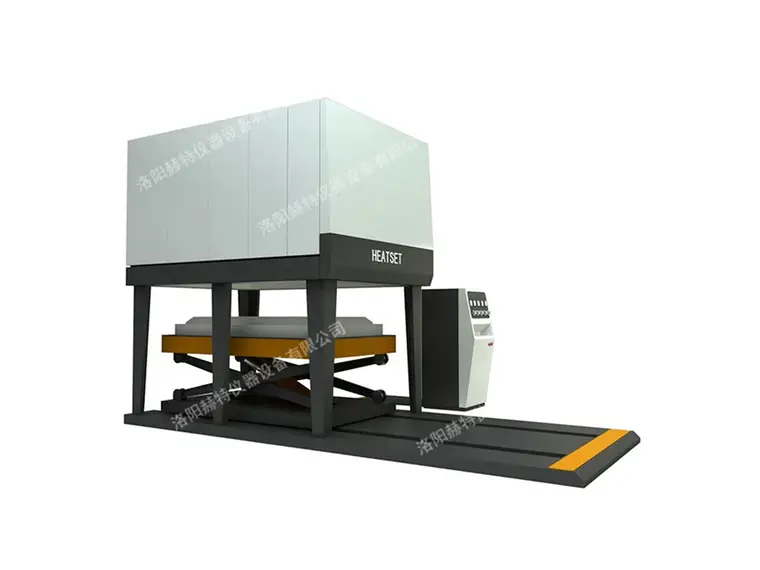
The market clusters around a handful of practical bands. Each has a typical element type, chamber construction, and application profile.
| Range | Typical Elements | Common Applications |
|---|---|---|
| Up to 1000 °C (1832 °F) | Nichrome wire | Ashing, drying, moisture and loss-on-ignition tests |
| 1000–1200 °C (1832–2192 °F) | FeCrAl wire | Ash content, glass annealing, powder pre-sintering |
| 1200–1400 °C (2192–2552 °F) | FeCrAl or SiC rods | Ceramic sintering, calcination, catalyst preparation |
| 1400–1600 °C (2552–2912 °F) | SiC rods, MoSi2 | Advanced ceramics, metal heat treatment, dental zirconia |
| 1600–1800 °C (2912–3272 °F) | MoSi2, graphite | Zirconia sintering, glass melting, crystal growth |
The 1000 °C and 1200 °C Class
These are the standard laboratory workhorses. Chambers are typically built from lightweight ceramic fibre board, which heats quickly and keeps the outer shell cool. They suit most ASTM ashing procedures, thermogravimetric sample preparation, and routine quality control in food, environmental, and materials labs.
The 1400 °C to 1600 °C Class
At this level, insulation grades change and chamber geometry becomes tighter to protect the elements. SiC rods need gradual, controlled heating and are sensitive to mechanical shock. These furnaces appear frequently in technical ceramics, metallurgy, and university research labs where sintering density matters more than cycle speed.
Above 1600 °C
MoSi2 elements operate happily in air at 1700–1800 °C, which makes them the practical top of the "air atmosphere" muffle furnace range. Beyond that, oxygen becomes the enemy: graphite and tungsten elements demand vacuum or argon/nitrogen purging, and the equipment shifts from a benchtop muffle furnace into a specialised high-temperature system.
Matching the Range to Your Application
Choosing a range starts with the material and the process outcome, not the furnace catalogue.
- Ashing and organic analysis — 550–900 °C is sufficient; buying a 1600 °C unit wastes budget and energy.
- Glass annealing and softening — usually 500–900 °C, with tight uniformity more important than peak temperature.
- Technical ceramic sintering — 1400–1650 °C for alumina and zirconia, where ramp control and soak stability determine final density.
- Metal heat treatment and calcination — 1000–1300 °C in most cases, occasionally higher for special alloys.
- Research on advanced oxides — 1700 °C and above, with atmosphere control.
Heatest Instrument builds muffle furnaces across these bands and generally advises buyers to specify the process temperature first, then add a 100–200 °C margin for safety and control headroom — not the other way around.
Why a Wider Range Is Not Automatically Better

A 1800 °C furnace used at 800 °C is not simply "more capable." Higher-rated furnaces use denser insulation, slower-responding elements, and heavier power supplies, which means slower heat-up, higher standby losses, and greater cost. Chamber uniformity can also suffer in oversized high-temperature chambers running at low setpoints, because the control loop is tuned for a different operating window. Match the range to the work, and reserve the extremes for processes that genuinely need them.
How to Specify the Right Range
- Define the highest sustained process temperature, not the peak experimental one.
- Add 100–200 °C of headroom for control stability and element longevity.
- Confirm the thermocouple type matches the working range.
- Check whether the atmosphere is air, inert, or vacuum — this can eliminate element options.
- Verify heat-up rate requirements; fast ramps and high temperatures rarely coexist cheaply.
- Consider chamber size against load mass, since a large load at high temperature demands more power.
Frequently Asked Questions
Can a 1200 °C muffle furnace run continuously at 1200 °C?
It can reach it, but continuous operation at the rated maximum accelerates element oxidation and insulation wear. For daily long holds, treat 1000–1100 °C as the realistic working ceiling.
What is the highest temperature a muffle furnace can reach in air?
Around 1800 °C with MoSi2 elements. Above that, oxidation of both elements and chamber materials becomes unmanageable, and vacuum or inert-atmosphere designs are required.
Does chamber size affect the achievable temperature range?
Yes. A larger chamber with a heavy load needs more installed power to reach the same setpoint, and uniformity at the top of the range becomes harder to maintain. Small chambers reach high temperatures more easily.
How accurate is temperature control at the top of the range?
Control accuracy depends on sensor type, controller tuning, and insulation. At 1700 °C and above, expect wider tolerances than at 800 °C, and consider a calibrated reference thermocouple for critical work.
Understanding the real relationship between rated maximum, continuous working temperature, and element technology turns a confusing specification into a straightforward purchasing decision. Pick the range your process actually occupies, add sensible headroom, and the furnace will hold its accuracy and element life for years rather than months.