
Choosing between a muffle furnace and a tube furnace is one of the first decisions any laboratory faces when planning high-temperature work. Both are resistance-heated furnaces capable of reaching 1000 °C or more, and both appear in the same applications: heat treatment, ashing, sintering, calcination, and materials research. The confusion arises because the two designs look similar on a specification sheet yet behave very differently once a sample is inside. A muffle furnace offers a large, open chamber for batch processing, while a tube furnace confines the sample inside a controlled-atmosphere tube. Understanding where those differences genuinely matter — atmosphere, temperature uniformity, sample size, and contamination risk — determines whether an experiment produces usable data. This guide compares the two designs point by point, drawing on the furnace engineering experience of Heatest Instrument.
How the Two Furnaces Are Built
Muffle Furnace Construction
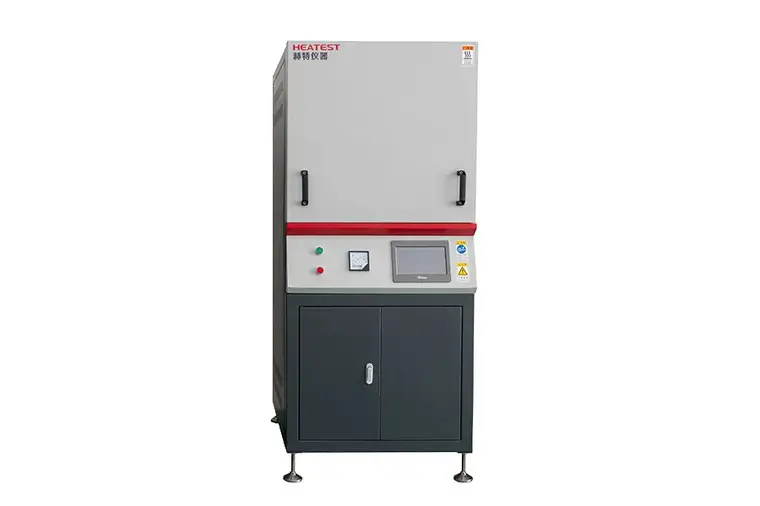
A muffle furnace uses an insulated chamber lined with ceramic fiber or refractory brick, wrapped with resistive heating elements on all sides. The "muffle" refers to the inner chamber that separates the sample from the heating elements, so the sample sees radiant heat rather than direct contact with a hot wire. That separation is the defining feature of the design.
Typical specifications include:
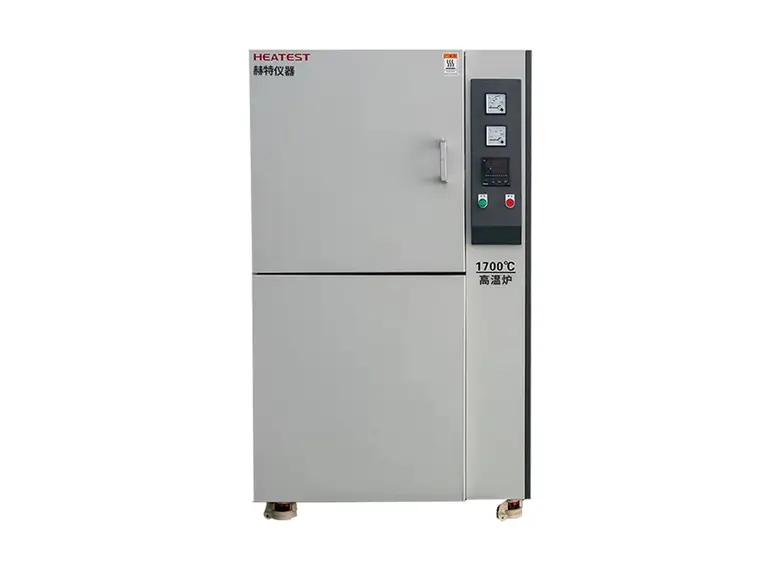
- Standard models reaching 1000 °C to 1200 °C; high-temperature versions using silicon carbide or molybdenum disilicide elements reach 1600 °C to 1800 °C.
- Chamber volumes from a few liters in benchtop units to hundreds of liters in industrial box furnaces.
- Doors that open from the front or top, allowing fast loading of trays, crucibles, and multiple samples at once.
- Kanthal-type (FeCrAl) wire elements for the lower range, ceramic elements for the upper range.
Tube Furnace Construction
A tube furnace wraps its heating elements around a cylindrical tube — typically quartz, alumina, or an alloy such as Inconel. The sample sits inside the tube, and gas flows through it or the tube is evacuated. This geometry is what enables atmosphere control.
A typical configuration includes:
- Quartz tubes rated to about 1100 °C to 1200 °C, and high-purity alumina tubes usable up to 1700 °C or higher.
- Vacuum flanges, gas inlet and outlet ports, flow meters, and sometimes a rotary mechanism for powder processing.
- Single-zone or multi-zone heating, with the latter providing a flat temperature profile over a defined length.
- Split-tube designs that open along a hinge so an existing tube or workpiece can be loaded without threading it through.
Muffle Furnace vs Tube Furnace: The Core Differences
1. Atmosphere Control and Sealing
This is the single most consequential difference. A muffle furnace is an open-chamber device. Air surrounds the sample, and while some models accept a gas inlet, the chamber is not designed to be gas-tight. Oxygen remains present, and any purge is imperfect.
A tube furnace, by contrast, is built around sealing. With proper flanges and gaskets, the tube can hold vacuum, inert gas, reducing gas mixtures, or even corrosive atmospheres. If your process involves preventing oxidation, carburizing, nitriding, or handling a material that reacts with air, the tube furnace is usually the only viable option of the two.
2. Temperature Range and Uniformity
Both designs cover overlapping temperature ranges, but the profile of the heat differs.
A muffle furnace heats a cavity, and the walls radiate uniformly onto the load. Temperature uniformity is generally good across the chamber, especially in smaller chambers, but the large thermal mass means slower heat-up and cool-down. Large industrial chambers can show measurable gradients near the door unless the manufacturer has compensated with multi-side element placement.
A tube furnace concentrates heat in a narrow cylindrical volume. Multi-zone control produces a very flat profile over a short heated length — often the tightest uniformity available in a benchtop furnace. The trade-off is that the useful hot zone is small, and the ends of the tube are inevitably cooler.
3. Sample Size, Shape, and Throughput
A muffle furnace accepts almost anything that fits through the door: crucibles, dishes, metal parts, ceramic substrates, stacked trays. Throughput is limited only by chamber volume.
A tube furnace accepts only what fits inside the tube bore — often 25 mm to 100 mm in diameter. Long, thin samples such as wires, rods, fibers, and foils are ideal. Bulk parts are not. If your work involves processing many samples per batch, the muffle design wins; if it involves a continuous flow of gas over a narrow specimen, the tube design wins.
4. Contamination and Cross-Sample Risk
In a muffle furnace, volatile components released from one sample can deposit on other samples or on the chamber walls. Ashing of organic material, for example, produces residues that accumulate over time. Regular burn-off cycles are part of normal maintenance.
A tube furnace isolates the sample inside a flowing gas stream, which carries volatiles away from the hot zone. Cross-contamination between samples is minimal because typically only one sample is processed at a time. For trace analysis or high-purity work, this is a decisive advantage.
5. Heating and Cooling Speed
The tube furnace's low thermal mass allows faster ramp rates; reaching 1000 °C in a small tube furnace can take a fraction of the time required by a comparably rated muffle chamber. Faster cooling is also achievable with forced gas flow. Muffle furnaces, with their thick insulation and large cavity, ramp more slowly and hold heat longer — which is an advantage when you want stability rather than speed.
Advantages Comparison at a Glance
| Factor | Muffle Furnace | Tube Furnace |
|---|---|---|
| Atmosphere control | Limited; open to air | Excellent; vacuum, inert, reducing, reactive |
| Sample capacity | Large; batch processing | Small; single or narrow samples |
| Uniformity | Good over a large volume | Excellent over a short hot zone |
| Ramp rate | Moderate to slow | Fast |
| Contamination | Higher cross-sample risk | Low; volatiles swept away |
| Typical use | Ashing, annealing, sintering, melting | CVD, calcination, reduction, catalysis research |
Which Furnace Fits Your Process?
The decision usually reduces to two questions: does the sample need a controlled atmosphere, and how large is the load?
- Choose a muffle furnace for ashing and ignition tests, glass and metal annealing, ceramics firing, sintering of multiple parts, and any process where the load is bulky and air exposure is acceptable.
- Choose a tube furnace for chemical vapor deposition, gas-solid reactions, pyrolysis under inert gas, catalyst activation and reduction, and work with wires, foils, powders in boats, or any sample that must not see oxygen.
- Consider both if your laboratory runs mixed workflows. Many materials labs operate a muffle furnace for general heat treatment and a tube furnace for atmosphere-sensitive work, which is often more economical than forcing one design to do everything.
Practical Selection Criteria
Beyond the design type itself, a few specifications deserve scrutiny before purchase:
- Maximum continuous temperature, not peak temperature. A furnace rated to 1200 °C peak may have a much lower recommended continuous operating temperature. Continuous rating is what governs element life.
- Heating element material. FeCrAl wire, silicon carbide, and molybdenum disilicide each imply different temperature ceilings, atmospheres, and replacement costs.
- Control accuracy and programming. Look for PID controllers with multi-segment ramp-and-soak programs and over-temperature protection, especially for sintering profiles.
- Tube material compatibility. Quartz reacts with certain alkali vapors at high temperature; alumina is more chemically robust but more expensive and slower to heat.
- Safety and exhaust. Processes that release fumes require ventilation or an exhaust port, regardless of furnace type.
Frequently Asked Questions
Can a muffle furnace be used with inert gas?
Partially. Some muffle furnaces include a gas inlet port for a light purge, which reduces oxygen but does not eliminate it. If oxygen must be excluded to a specific residual level, a tube furnace or a sealed atmosphere furnace is the correct choice.
Is a tube furnace more accurate than a muffle furnace?
Accuracy depends on the controller and thermocouple placement, not on the furnace type. A tube furnace generally achieves a flatter profile within its small hot zone, but a well-designed muffle furnace can hold ±5 °C across a modest chamber.
Which is better for ashing?
A muffle furnace. Ashing requires an open, oxidizing environment and often multiple crucibles at once — exactly what a muffle chamber provides.
Which is better for sintering metal powders?
It depends on the metal. Powders that oxidize readily need the tube furnace's inert or reducing atmosphere. Oxide ceramics that tolerate air can be sintered in a muffle furnace with better throughput.
Final Thoughts
The muffle furnace and the tube furnace are not competitors so much as instruments built for different jobs. The muffle furnace offers volume, simplicity, and open-air processing; the tube furnace offers atmosphere control, isolation, and a tightly controlled hot zone. Attempting to use one for the other's purpose usually produces compromised results — oxidized samples, contaminated chambers, or wasted cycle time.
Start with the sample: its size, its chemistry, and the gas environment it requires. Those three factors will point to a single answer in most cases. Working with an experienced supplier such as Heatest Instrument helps ensure the final specification — chamber volume or tube diameter, element type, control system, and safety features — matches the process rather than simply the budget.