STEP 1
Compliance with YB/T4130 Test Standard
Ensures that the thermal conductivity measurements are accurate and consistent with industry standards, providing reliable data for material analysis.
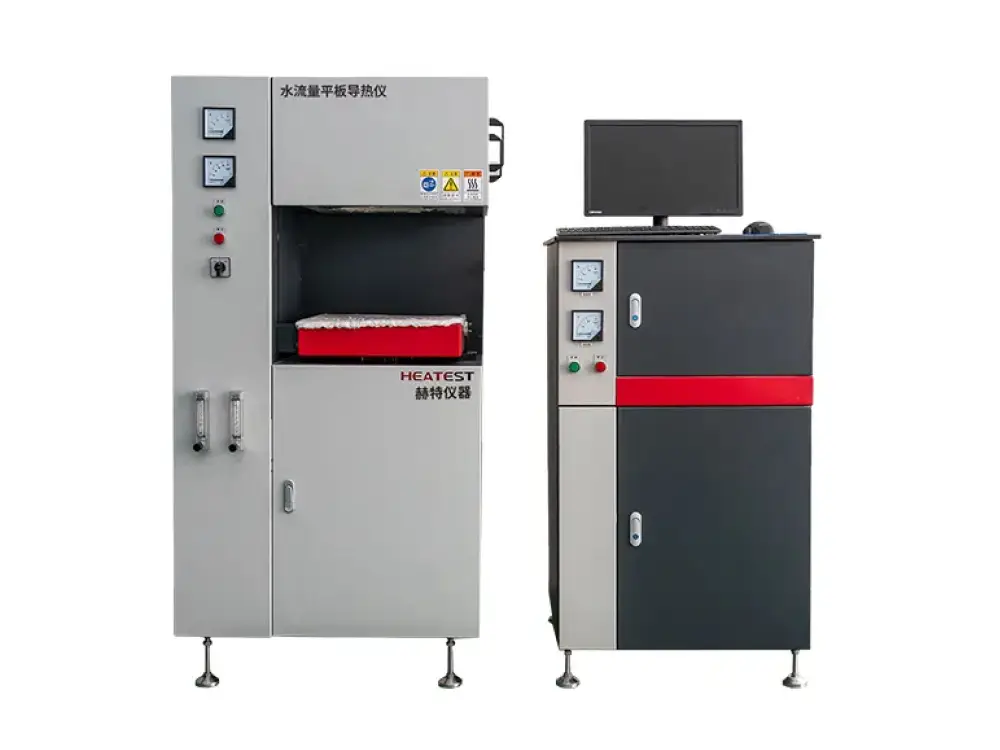
The thermal conductivity tester (plate method) is engineered to measure thermal conductivity of refractory fibers, insulation boards, bricks, and amorphous refractory materials within a temperature range of 200-1300℃. It adheres to the YB/T4130 test standard, ensuring accurate and reliable results for thermal conductivity values between 0.01-3.0 W/(m·K).
The thermal conductivity tester (plate method) is a crucial tool for assessing the thermal properties of various insulation materials. It operates within a temperature range of 200-1300℃ and measures thermal conductivity from 0.01 to 3.0 W/(m·K). This equipment is designed to meet the YB/T4130 test standard, providing precise measurements of heat flow through samples.
Our tester is composed of a heating furnace, a microcomputer measurement and control system, a cooling circulating water system, a calorimeter system, and a constant pressure water system. This comprehensive setup ensures that the tester can handle a variety of materials, providing accurate and consistent results.
The PBDR—HT13A, PBDR—HT15A, and PBDR—HT13 models are designed to cater to different testing needs, with varying working temperatures and sample sizes. The automatic and manual testing modes offer flexibility in operation, making this tester suitable for both routine and specialized testing.