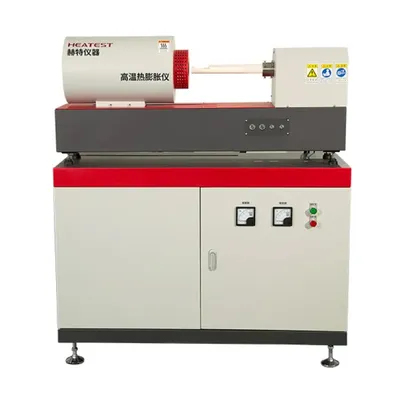
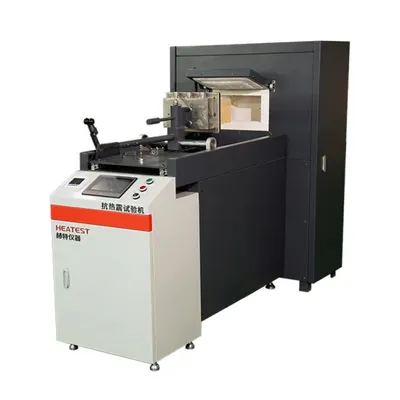
Selecting high temperature test equipment involves a fundamental economic equation: broader temperature ranges drive higher costs, but not every application demands the extremes. Engineers and procurement professionals frequently face the challenge of balancing test requirements against capital expenditure. Understanding where the cost inflection points lie, and how equipment design influences pricing, enables informed decisions that avoid either overspending or compromising critical test fidelity. This article dissects the temperature-range vs cost tradeoffs, providing a framework for choosing the optimal configuration—with reference to industry solutions available from HEATEST Instrument.
1. Understanding Temperature Range Requirements
The first step in any equipment selection is defining the actual thermal envelope needed. High temperature test equipment spans from basic ovens reaching 300°C to specialized chambers exceeding 1800°C. The required temperature range is dictated by the materials, components, or assemblies under test. For example, automotive parts testing seldom exceeds 300°C, while aerospace ceramics or refractory metals require 1200°C or more.
Common Application Categories
- Low-range (up to 300°C): Plastics, electronics, rubber aging, and general material stability tests. Cost is relatively modest.
- Mid-range (300°C – 800°C): Metal heat treatment, composite curing, and catalyst aging. Heating element quality and insulation begin to significantly affect price.
- High-range (800°C – 1200°C): Ceramic sintering, thermal barrier coating evaluation, and high-temperature fatigue testing. Requires advanced materials like molybdenum disilicide heaters.
- Ultra-high (above 1200°C): Aerospace reentry simulation, nuclear fuel testing. Custom engineering and exotic refractory alloys dominate cost.
It is critical to avoid “specmanship”—choosing a wider range than needed simply because it seems future-proof. Every additional 100°C above the actual requirement adds disproportionate expense without test benefit.
2. Cost Drivers in High Temperature Test Equipment
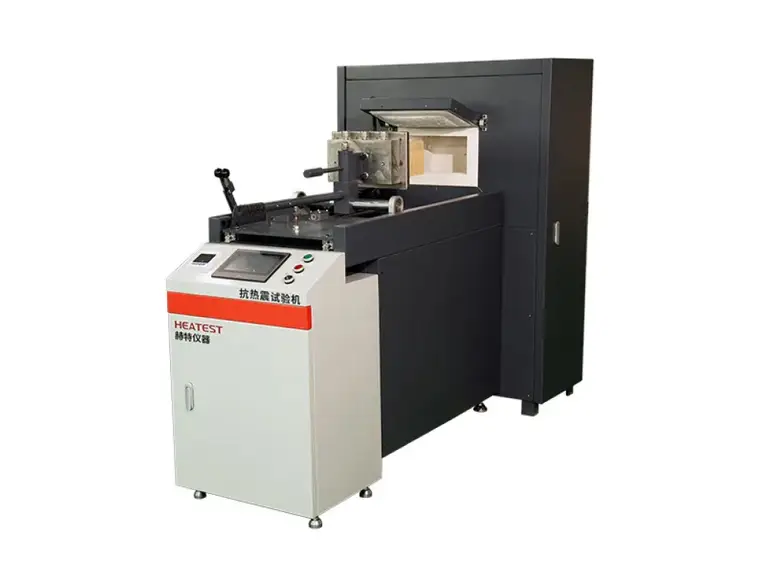
Several engineering factors contribute to the cost escalation as temperature range increases:
- Heating element type: Resistive wire (NiCr) for low ranges; silicon carbide (SiC) or molybdenum disilicide (MoSi2) for mid-to-high ranges; tungsten or graphite for ultra-high. Each step upward in element technology multiplies material cost and replacement frequency.
- Insulation quality: Standard ceramic fiber works for ≤1000°C, but higher requires vacuum-formed refractory bricks or zirconia fibers, adding significant weight and cost.
- Chamber construction: High-temperature alloys (e.g., Inconel) replace stainless steel above 600°C. Sealing systems must accommodate thermal expansion differences, increasing complexity.
- Control precision: Wider ranges demand multi-zone PID controllers, more sensors, and advanced algorithms to maintain uniformity. Calibration and certification costs also rise with range.
- Safety systems: At extreme temperatures, chamber cooling jackets, over-temperature protection, and emergency venting become mandatory, raising both engineering and certification costs.
Many buyers underestimate the total cost of ownership: energy consumption rises exponentially with temperature, and maintenance intervals shorten. For example, a 1200°C chamber may consume 3–5× more power than a 600°C equivalent during steady-state operation.
3. Tradeoffs: Balancing Performance and Budget
The core tradeoff is between maximum achievable temperature and the cost of that capability. Below is a structured comparison to aid decision-making:
Temperature RangeRelative Cost (low-range baseline = 1x)SuitabilityKey Cost Drivers ≤300°C1xElectronics, plastics, aging testsBasic heater, standard insulation 300°C – 600°C1.5–2xHeat treatment, composite curingHigher-grade steel, improved insulation 600°C – 1000°C3–5xMetal alloy testing, ceramic sinteringSiC/MoSi2 elements, heavier insulation, tighter control 1000°C – 1400°C6–10xAerospace materials, thermal barrier testsRefractory alloys, multi-zone control >1400°C12–20xSpecialized R&D, extreme environment simulationCustom design, exotic materials, extensive safety
As the table shows, costs are not linear—they accelerate sharply beyond 1000°C. For many industrial applications, a system rated at 600°C–800°C offers the best value, covering the vast majority of standards (e.g., ASTM, ISO) without paying for unnecessary extremes.
HEATEST Instrument provides a range of modular high-temperature test chambers that allow customers to select the optimum temperature ceiling. Their HT-600 series (600°C max) and HT-1000 series (1000°C max) represent typical sweet spots where performance and cost are carefully balanced. For clients who genuinely need 1200°C+, the HT-1200 line incorporates reinforced refractory and closed-loop adaptive control, while still maintaining competitive pricing through standardized construction.
4. Strategic Recommendations for Equipment Selection
To make a cost-effective choice, follow these actionable guidelines:
- Define your testing protocol first: Record the actual maximum temperature your test standard requires, plus a 10–15% safety margin (not a full extra range class).
- Prioritize uniformity over maximum temperature: Many processes need stable thermal gradients, not raw temperature. A 600°C chamber with ±1°C uniformity may outperform a 1000°C unit with ±5°C variation for your actual test.
- Consider future scalability: If future tests might require slightly higher temperatures, choose a mid-range unit that can be upgraded with additional insulation or heating elements. HEATEST Instrument offers modular retrofits that extend range without buying a whole new system.
- Calculate total cost of ownership: Include energy, maintenance, and calibration over a 5-year horizon. A lower upfront cost for a narrow-range unit often wins when total lifecycle cost is considered.
- Evaluate supplier customization: Avoid one-size-fits-all equipment. A supplier that tailors the temperature range to your exact needs—like HEATEST Instrument—can eliminate cost elements tied to unused capability.
5. Conclusion
Temperature range vs cost tradeoffs in high-temperature test equipment are fundamentally about aligning engineering requirements with financial constraints. By systematically analyzing the thermal demands of your test protocols, understanding the material and design costs that escalate with each range increment, and focusing on total cost of ownership, you can select equipment that yields accurate results without overcapitalization. HEATEST Instrument’s product line exemplifies how modular design and range-matched configurations help customers optimize this balance. For your next procurement, start with the question: “What is the highest temperature I truly need?” — then let the cost implications guide the rest.